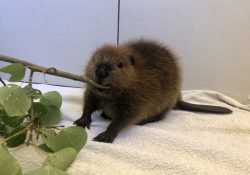
Beavers
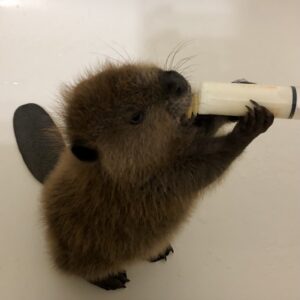
Beavers and other semi-aquatic mammals are complex species to rehabilitate due to their unique social and health needs. Interior Wildlife is one of the few rehabilitation centers in BC equipped with an aquatic facility to house and care for mammals year-round (such as beaver or river otter). If you've found an injured adult or displaced beaver kit that still fits into the palm of a hand, please take a picture of the animal and its surroundings. Then email us for further directions before you do anything.
For any questions about our beaver co-existence program, go to our:
"Human Beaver Coexistence" section.
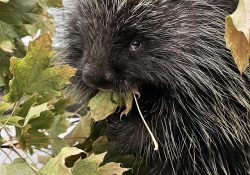
Porcupines
Another local large rodent is the porcupine. A very peaceful and slow moving herbivore living in our forested neighbourhoods. Okanagan porcupines (adult or juvenile) commonly get injured on roads, sometimes by pets. A baby porcupine below a tree where its mother is feeding above, is a common sight and doesn't mean it is orphaned. Please contact us first if you believe that a porcupine needs human care. They have 30.000 reasons for you to not touch them!
We can certainly house and treat porcupines. Notify us as soon as possible via email if you find an injured or sick porcupine.
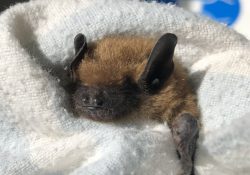
Bats
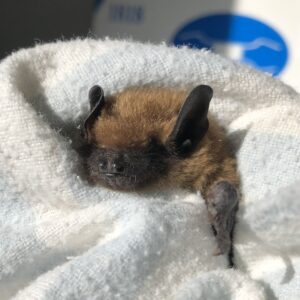
A lot of insect-eating bats are native to the Okanagan. Displaced, cold or young grounded bat pups that may be learning how to fly and commonly have difficulty taking flight off the ground. Usually they crawl to a vertical surface, to be able to take flight when it gets dark outside.
If you see a grounded bat or bleeding bat, a bat with a broken bone or torn wing membrane, please call the Okanagan branch of BCbats program:
1-855-922-2287 (ext 13)
and obtain further directions BEFORE touching the animal WITH gloves.
We can certainly house and treat bats, but collection has to be done responsibly and only if the animal is actually injured.
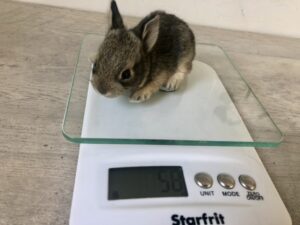
Cottontail Rabbits
Native wild cottontail rabbits sometimes get injured by pets or their nests get displaced by construction. If any juveniles you have found are not injured, the best course of action is to put them back where found so the mother can find her young. Mother rabbits leave their babies but come back to nurse them in the evening. If you have to add nesting materials or make a new “makeshift nest” close to where you’ve found a destroyed nest. We do NOT advise to check frequently in person as this will stress out this illusive and high-stress species. Wild juvenile wild rabbits have the best chance of survival if raised by their own parents. They do very poorly in human care and are very much unlike domestic rabbits that would thrive in captivity.
If the mother is seen dead (hit by mower, car or bit by pets such as cats or dogs), please email us for further directions. Always include a picture and ideally a weight for wild rabbit inquiries.
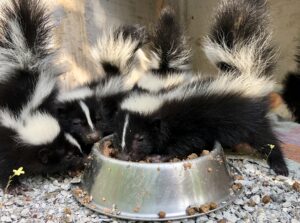
Skunks
Sometimes skunks make their nests under human structures. Unwanted skunks can easily be excluded to avoid this. Here is how you can help:
1. To reunite mother & young, give adult female access to babies. She will "relocate" her nest to an alternative spot within her territory herself.
2. To evict and exclude adult skunks that may be looking at nesting under a porch or in a shed. You can call a "wildlife control contractor". We are happy to give you reputable and humane contacts that will help you with excluding skunks. Trapping and relocating skunks is NOT humane.
Truly orphaned skunk kits can be collected if the mother has been seen dead. A lone baby skunk that can fit into the palm of your hand is not a normal sight. Email us for further directions on truly orphaned skunk kits.
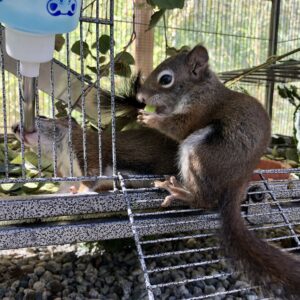
Red Squirrels
Squirrel species we may rehabilitate and release are: reds & douglas & northern flying squirrels as well as chipmunks. More info on squirrels in the FAQ's section below! Note that we are required to release squirrels within a 10km radius of it's place of origin.
Note: We are NOT permitted to rehabilitate pocket gophers & invasive grey squirrels. Greys are twice the size of native squirrel species and can be grey or black in colour (even as babies with eyes still closed). If you are unsure what type you have found, email us a picture and ideally a weight.
If you have found an injured invasive squirrel species, email us for further directions.
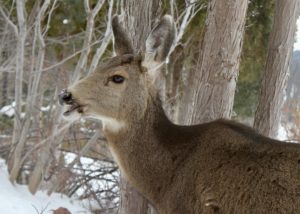
Adult Deer
Please know, that injured ADULT deer are NEVER candidates for rehabilitation in our province. This is due to their high stress levels in captivity (and a fatal condition called „capture myopathy“). Adult deer are very likely to develop this life-threatening issue when handled or captured for human care. Additionally, disease transfer amongst deer of any age in our valley is a concern. This led the local authorities to prohibit rehabilitation for deer fawns in the Okanagan. Young and mature deer are susceptible to "Chronic Wasting Disease" and testing of this disease is not possible on live animals in BC, Canada.
Please note: Interior Wildlife is NOT permitted to rehabilitate deer as per our local government authorities.
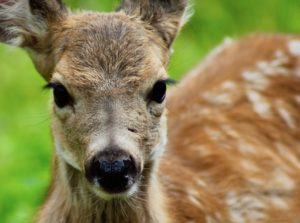
Fawns
Deer fawns are left alone (for 6-8 hrs/day) by the doe (their mother) for the first 2 wks of their life. Most fawns are intentionally left (or hidden from predators) by their mothers who are foraging for food. She returns to feed her fawn a few times a day (usually at dusk & dawn). If you find a fawn lying quietly, hiding in grass or brush, don’t disturb them. Fawns can’t follow their mothers for the first two weeks, so they spend nearly all their time alone. Fawns are only cat-sized when born, please rest assured that they may look small and weak to you, whereas they are likely to be healthy and fed daily by their mother.
Please note: Interior Wildlife is NOT permitted to rehabilitate deer fawns. We can NOT transfer fawns outside of the Okanagan for rehabilitation.
We are here to help by providing advice and guidance via email about mule deer fawns in our communities!

Raccoons
Rehabilitation and release of raccoons is banned in the Interior of BC by the local government.
Currently, the only option to help severely injured or sick raccoons is humane euthanasia. For this legal live-trapping of the animal should be considered by a permitted person.
Simply displaced babies or unwanted raccoon families have more options.
Here is how you can help:
1. To reunite mother & young (give adult female access to babies). She will "relocate" her nest to an alternative spot close-by if she has access to it.
2. To evict and exclude adult raccoons that may be looking at nesting in your attic and raising their young in a human house.
Please note: Interior Wildlife is NOT permitted to rehabilitate raccoons.
We will provide advice and guidance via email about urban raccoons in the Okanagan!
Via e-transfer
E-transfer us directly and 100% of your donation goes to us: donate@interiorwildlife.ca
Via PayPal
Click on the icon below to get
re-directed to our PayPal account for secure credit card payment
Via Canada Helps
Click on the icon below to get re-directed to our charity account with CanadaHelps.org
Via Snail Mail
Send a cheque to our office:
PO Box 988
V0H1Z0, Summerland,
BC,
Canada